
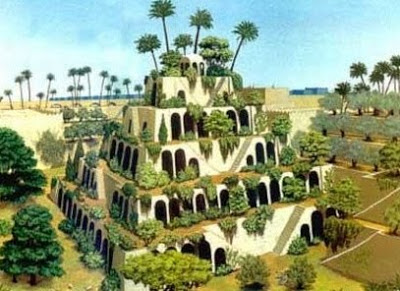
The Hanging Gardens of Babylon are perhaps the most mysterious of the original wonders. Said to have been built around 600 BCE by King Nebuchadnezzar II for his wife Amytis, the gardens were described by ancient historians as an extraordinary series of terraced gardens rising high above the city of Babylon.
According to legend, Amytis longed for the lush green hills of her homeland, and Nebuchadnezzar commissioned the gardens to recreate a natural paradise. They were said to consist of tiered terraces filled with an abundance of trees, shrubs, and flowers, watered by an advanced irrigation system that lifted water from the Euphrates River.
Despite detailed accounts from writers like Strabo and Philo of Byzantium, no definitive archaeological evidence has been found to confirm their existence. Some scholars believe the gardens may have been purely mythical or confused with other ancient gardens, such as those in Nineveh.
If the gardens did exist, their construction would have required innovative engineering, including the use of aqueducts and pumps to raise water to the elevated terraces. This would have been an extraordinary feat in the arid Mesopotamian environment.
The gardens symbolize humanity’s yearning to bring nature into urban life and create spaces of beauty and peace amidst the harshness of the environment. Whether fact or fiction, the Hanging Gardens have inspired countless artists, writers, and architects.
Through the centuries, the idea of “hanging gardens” has become synonymous with the blending of nature and architecture, influencing garden design worldwide.