
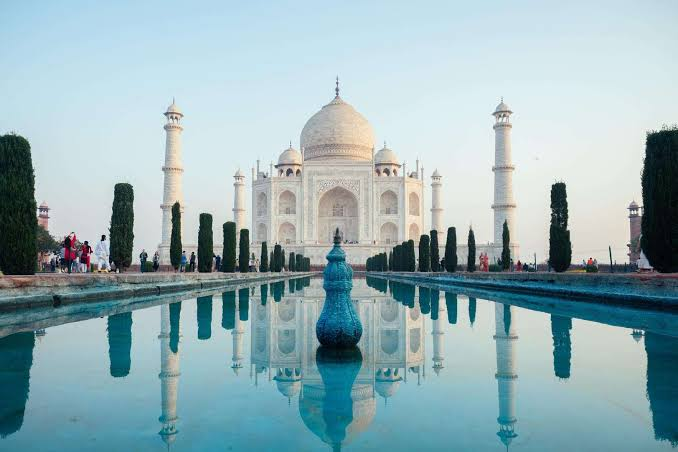
The Taj Mahal, located in Agra, India, is one of the most iconic and breathtaking monuments in the world. Often described as the jewel of Muslim art in India and a masterpiece of Mughal architecture, it attracts millions of visitors annually and is recognized as a UNESCO World Heritage site. More than just a beautiful building, the Taj Mahal is a symbol of eternal love, artistic brilliance, and cultural fusion.
Historical Background
The Taj Mahal was commissioned by the Mughal Emperor Shah Jahan in 1632 as a mausoleum for his beloved wife Mumtaz Mahal, who died during childbirth. Devastated by her death, Shah Jahan vowed to build an unparalleled monument in her memory.
Construction began in 1632 and continued for over 20 years, involving thousands of artisans, craftsmen, and laborers from across India, Persia, the Ottoman Empire, and Europe. The chief architect is believed to have been Ustad Ahmad Lahauri, though many contributed to its design and execution.
The Taj Mahal is more than a tomb; it is part of a larger complex that includes a mosque, a guest house, formal gardens, and ornate gateways, all designed to create a harmonious and serene environment.
Architectural Design and Features
The Taj Mahal is renowned for its stunning symmetry, intricate detail, and harmonious proportions. It combines elements of Islamic, Persian, Ottoman Turkish, and Indian architectural styles.
Main Mausoleum: The central structure is built from white marble that changes color depending on the light—pinkish in the morning, milky white in the evening, and golden under moonlight. The marble is inlaid with precious and semi-precious stones in intricate floral patterns, a technique called pietra dura.
Dome: The massive onion-shaped dome rises about 35 meters (115 feet) high and is surrounded by four smaller domes. The main dome is topped with a gilded finial combining Islamic and Hindu decorative elements.
Minarets: Four slender minarets, each about 40 meters (130 feet) tall, frame the mausoleum’s corners. These are designed slightly outward to protect the tomb in case of collapse.
Calligraphy: Elegant calligraphy of Quranic verses adorns the entrance portals and walls, executed with black marble and agate.
Gardens: The surrounding gardens follow the classic Persian Charbagh layout, symbolizing paradise, with water channels, fountains, and symmetrical flower beds.
The entire complex is oriented to align with the cardinal points, reflecting precise astronomical knowledge.
Symbolism and Cultural Significance
The Taj Mahal is often called a “monument of love” because it was built as an enduring tribute to the love between Shah Jahan and Mumtaz Mahal. This romantic narrative has made it a symbol of devotion worldwide.
Beyond romance, the Taj Mahal reflects the zenith of Mughal culture, which blended Persian, Islamic, and Indian artistic traditions. It represents the empire’s wealth, power, and cultural sophistication during its golden age.
The mausoleum also serves as a spiritual symbol, with its garden representing paradise and the tomb itself symbolizing the eternal resting place of the soul.
Construction Techniques and Challenges
Building the Taj Mahal was a colossal undertaking involving advanced engineering and artistry for its time.
Materials: Marble was sourced from Makrana in Rajasthan, over 300 kilometers away. Precious stones such as jade, crystal, lapis lazuli, amethyst, and turquoise were imported from various parts of Asia and Europe.
Craftsmanship: Skilled artisans used calligraphy, carving, inlay work, and lattice screen carving to decorate the monument with unparalleled detail.
Water Supply: An innovative system of water channels and wells was developed to supply the gardens and fountains, reflecting sophisticated hydraulic engineering.
Despite the grandeur, the construction was not without hardship. Thousands of workers labored under challenging conditions, and legends speak of Shah Jahan’s desire to build a black marble mausoleum opposite the Taj Mahal for himself—though this was never realized.
Later History and Preservation
After Shah Jahan’s death, the Taj Mahal remained a royal tomb, but its grandeur attracted both admiration and threats.
During the 18th century, the monument suffered neglect and damage, including looting of precious stones and vandalism during invasions.
In the 19th century, British colonial rulers initiated restoration efforts led by Lord Curzon, recognizing the Taj Mahal’s global cultural significance.
Today, the Taj Mahal faces challenges due to pollution, environmental degradation, and the impacts of mass tourism. Conservation efforts are ongoing to preserve the monument’s delicate marble and intricate artwork.